Tag: life

  • The Art of Writing About Art

    The Art of Writing About Art

    I started this blog in conjunction with my stained glass website for a couple of reasons. For one, I just love writing about art and stained glass. I am deeply enthusiastic about promoting artists, describing the stained glass process and ruminating on my inspirations. Writing about the intentions driving my art really helps to remind me of the “why.”

    The “why” is fundamental to art being more than just a “side hustle.” I’m often plagued with the Capricorn tendency to make sure every moment of my day is *productive.* If I’m not doing three things at once, maximizing my time, crossing things off a list–well, then I’m just not reaching my full potential, right? But now that I’m older and possibly wiser, I’m realizing how fast time is flying while I’m multi-tasking my life away. Art can be mindful. Art can help me slow down. Art doesn’t always have to be productive, a business, something to mass produce. It’s valuable on its own. The act of making is valuable.

    The act of writing about making–that’s valuable too, for me. Often I can find myself creating with abandon and focusing so much on the end result that I’m not taking the time to enjoy the process. Being mindful of my “why” can slow down the pace of what I’m doing and help me to learn more about myself in the process. Why do I favor these colors, this texture, that shape? What mood am I trying to evoke for someone else viewing the piece? What does my art remind me of, why is it comforting to me, what memory does it touch in the back of my mind?

    I’ve also learned that if something doesn’t exist on the internet that you wish existed on the internet, then maybe you’re the one that has to make it. I would love reading a weekly blog for stained glass artists rather than just endlessly scroll TikTok videos in the community. I’m much more interested in the old style of connection: message boards, chat rooms, blogrolls. I’m only 37, okay, but I do miss the golden age of the internet. Instagram and TikTok can only do so much to connect people, and it’s really just a place for most people to lurk. Don’t get me wrong, I love making reels as much as the next stained glass artist, but I miss longform content! I’m probably the only one.

    I love writing about stained glass art and how my life is growing alongside my skills. I’m holding onto my intention and making sure everything I design and create is filtered through that purpose.

  • Yoga for Stained Glass Artists

    Yoga for Stained Glass Artists

    I think most artists would agree that making, crafting, and creating is a physical act. Artists put their blood, sweat, and tears into their projects–emphasis on the “blood” for stained glass artists. Memo: glass can be sharp.

    We often put our backs into what we love, and then throw our backs out in the process. It’s easy to shrug and say it’s the cost for creating. The aches and pains in our arms, wrists, legs and necks can be a testament to a job well done: an afternoon spent on hyper-focusing, a late night fully invested in the minutiae, a few precious hours of uninterrupted creation. And then you wake up out of your fugue state and realize you’ve been in the same position for four hours with your neck in that weird tilt, your wrists locked up with overuse, and you’re screwed because you’re in your thirties and you forgot to stand up and drink water at least once an hour. Is that just me?

    I don’t feel like I’m alone in needing to physically decompress after a few hours of intense crafting, so I’m compiling a playlist of yoga stretches for the stained glass maker. There are some great resources out there for artists of all varieties, but this playlist is going to be heavy on the wrist, neck and back stretches for hours spent hunching over glass pieces, soldering away.

    Sometimes time just doesn’t exist when I’m smoothing out some juicy lines of solder on a suncatcher. Clocks don’t hold a candle to the flow state. But when that happens, god forbid I have to shelve books at the library the next day–I’ll bend down and never get back up.

    Prioritizing my health (physical and mental) has been one of the hardest things I’ve learned to do over the years. At the end of the day, it’s pretty easy to take five to ten minutes to shake out the strain and stretch the stress from my shoulders–all the stress that accumulates from making art, but also work and life and plans and all the things that build up over a lifetime of being busy. I’m discovering that the more I focus on easing that concentrated stress from my muscles, the easier it is for me to just function well.

    Dropping my stained glass artist playlist here, made on my new YouTube channel! The playlist itself is collaborative, so if you’re an artist and you have videos you’d like to include, please let me know. I’ve been doing yoga for over 20 years now, so I hope to someday start sharing my own stretch routines for stained glass artists on the channel. Thanks for following along and I hope I see you on the mat!

  • Audiobook Suggestions from a Full-Time Librarian, Part-Time Artist

    Audiobook Suggestions from a Full-Time Librarian, Part-Time Artist

    I’ve seen a lot of artists compile their favorite playlists for the workshop, so I wanted to take a crack at it. This is where my librarian roots really kick in though, because I love to listen to audiobooks! There are so many different steps to stained glass art and each one requires a certain amount of concentration, but grinding and taping is where I clock the most audiobook minutes.

    Grinding glass might be my least favorite part of the stained glass process, and any glass artist that tells you otherwise is a freakin’ liar. Anything that’ll keep me entertained while I’m making pass after pass against a grinding bit is a godsend. So for any patrons or artists who may be interested, below is a list of my absolute favorite thrillers I’ve listened to while making glass art.

    All of these were checked out on the Libby app through my local library system. If you’re paying for audiobooks..why? Borrow them from the library for free and support your community in the process!

    1. Freida McFadden, “The Coworker” – Such a quirky neurodivergent main character, and I LOVED the twist!
    2. Alice Feeney, “Beautiful Ugly” – l loved the narrator’s voice on this one and it kept me guessing. I remember washing plant stakes in the sink and my jaw dropping, I kept scrubbing just to finish the chapter. Those patinas came out great!
    3. Marisa Kashino, “Best Offer Wins” – Women justifying bad choices is probably my favorite modern literary trope.
    4. Virginia Feito, “Victorian Psycho” – Bret Easton Ellis’ Psycho but Victorian, just as the title suggests. Love an extremely unhinged revenge story.
    5. Lucy Foley, “The Guest List” – A big mix of interesting characters and multiple narrators, it was a very fun murder mystery.
    6. Alex Michaelides, “The Fury” – The unreliable narrator on this audiobook was so good, I’ll forever think about his voice! I must’ve cut a hundred more glass leaves than I needed, getting lost in the book.

    I hope this little list is satisfying, and if you ever need a book suggestion from your resident glass artist/librarian, I’m here for you! Just shoot me an e-mail through the contact form and I’ll make you a custom book recommendation list for any hobby.

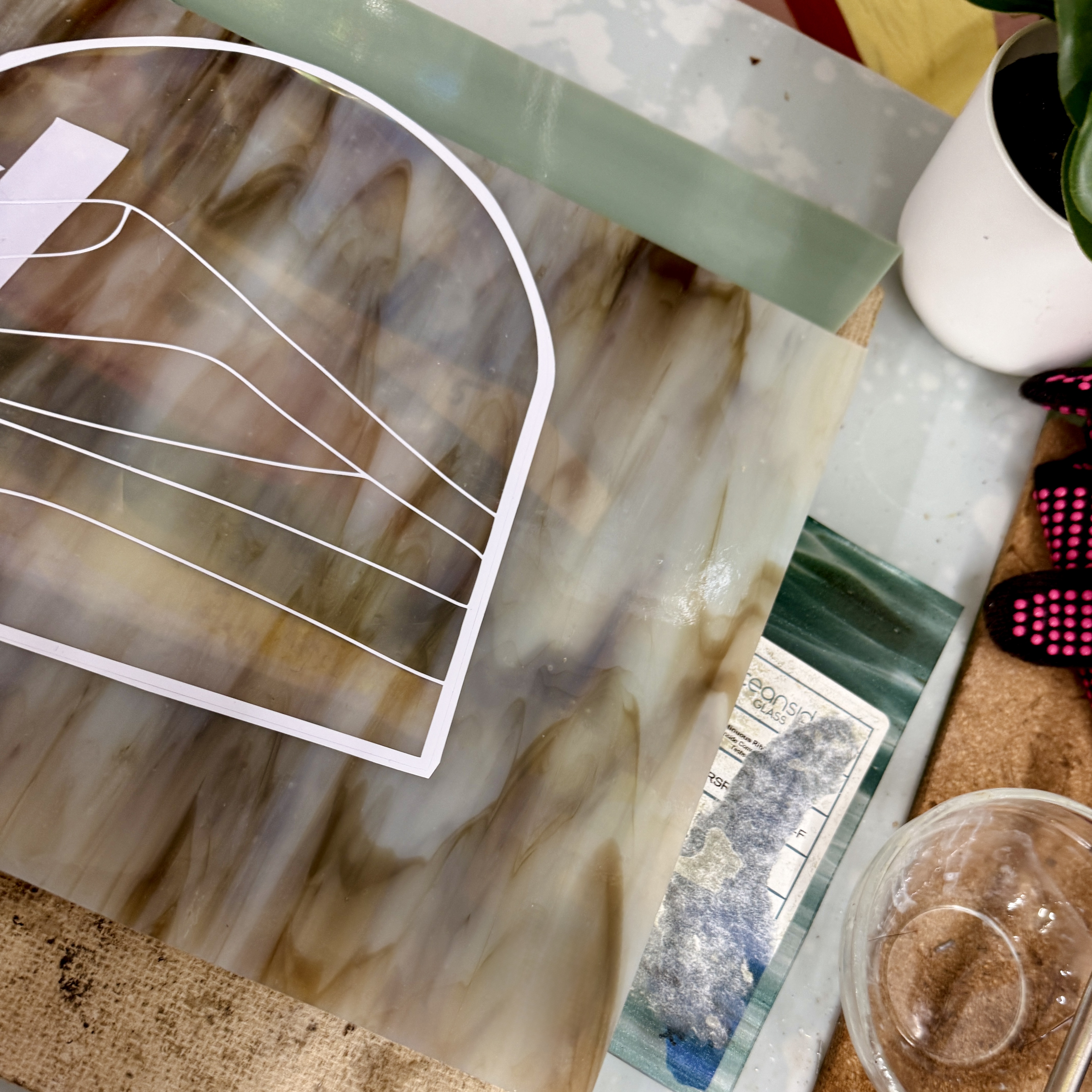
    Made this pink plant arch while listening to “Hungerstone” by Kat Dunn!

  • Embracing Experimentation in Stained Glass Art

    Embracing Experimentation in Stained Glass Art

    I’ve been fully immersing myself into artistic content for a while now, hoping to surround myself on social media with mosaic and stained glass artists. Being inundated with the art I love helps the creativity flow; it stokes the obsession, and it’s a great way to spread positivity. If I haven’t left at least ten positive comments on other artists’ reels in a day, I’m not awake.

    And I’m learning so much as I’m observing and participating in the community. Something that artists generally tend to do that’s a really great life philosophy is to experiment with subject, process and style. I don’t think there’s any type of art out there that can be done only one way to achieve only one type of end goal. Everyone seems to do it a little uniquely, and glass art is no different. There’s no one way to make stained glass art, and there seems to always be something new to learn. “But that’s not how it’s done” isn’t typically a refrain you read in comments for glass art, at least not on the reels I see. The predominant comments are always “I’ve never tried that before!” or “I’ve tried it this other way and it worked, too!”

    Experimenting can be difficult to do when you get into a little stubborn groove in life. If I stumble into what works and get comfortable there, I may never have TIME to try something new. Who has the stamina to experiment with different techniques when we already have one that kinda works okay? Usually, most of the time? And that’s why it’s awesome to be part of a community of artists who live to experiment and try new things.

    One of my favorite experimenters on Instagram & YouTube is Grizzly Glass Art. He makes step by step tutorial videos about every part of the stained glass process, which I know beginners and even seasoned veterans are appreciating so much. It takes so much time (and sometimes so much money, when it comes to expensive hobbies like stained glass) to experiment and possibly fail. So Grizzly Glass does it for us. Thinking about experimenting with different brands of patina? He’s done side by side demonstrations. Worrying about how to incorporate hobby came or zinc came to your borders? He’s gathering advice from other artists and demonstrating multiple techniques. It’s really freeing to watch someone film themselves TRY, without fading to black and a perfect finished product. There are a lot of artists out there filming their process, including their experiments, to help the larger stained glass community. Not only do I (and the wider community) appreciate the effort, but it’s an ongoing reminder that we should never stop trying.

    Sometimes the experiments fail, and that’s when we learn the most–another unfortunate but powerful life lesson. Observing other artists continue to try, continue to make changes and alter their methods, seeking not just to improve but to share that knowledge, it’s truly humbling.

    In that spirit, I’m going to try a new method of patina application I’ve seen a few artists do on Instagram lately. Applying Kwik flux cleaner and patina together at the same time? Seems like a horrifying prospect, but I’ll never know until I try something new. So cheers to all the makers who are experimenting and sharing the journey! I hope to start adding to the community in my own way–maybe not with step by step videos, but perhaps with very intentional reinforcement and encouragement. How about a stained glass cheerleader, shouting to the sky about how cool y’all are? I can do that.

  • Nostalgia and Beauty: Birds of Paradise

    Nostalgia and Beauty: Birds of Paradise

    Birds of Paradise plants in California
    Birds of paradise growing outside my mother’s old house in California

    If you’re seeing a lot of tropical floral themes in my art this spring, there’s a good reason–I’m yearning for a sense of “home”, a slice of comfort and nostalgia. For that, I turn to the bird of paradise.

    I replicate the shape of the bird of paradise in my art quite a bit because the plants remind me of where I grew up. My mother’s old house has a beautiful array of birds of paradise. Growing like wild stalks, birds of paradise are prolific in California. They grow in yards without fuss, blossom like an after thought along median strips on highways. They’re everywhere in Cali, like wild cacti, red rocks and the Santa Ana winds. It’s something I took for granted in the landscape when I lived there. Now that I’m in North Carolina, the scenery I’d ignored for so long has become my special interest. Funny how time and distance can make you yearn for the things you took for granted.

    The flower itself is a little alien against the backdrop of a desert landscape; the blooms unfurl with such pronouncement, bright orange and deep violet, in stark contrast to the dark green foliage. The orange petals look like a bird in flight, hence the name. They’re a subtropical coastal plant from South Africa, displaced in the 1700’s, now thriving confidently along the California coast.

    I’m fairly obsessed with birds of paradise. I have a few plants that live on the deck during warmer months and I bring inside for the winter. They blossom in January, almost like it’s a gift for my birthday. I take endless pictures of the birds, celebrating them like they’re a part of the family. My husband and I bought an MCM Letterman oil painting of birds of paradise at the vintage store Red Collection in Greensboro (pictured below.) It lives in our den, in spite of my husband’s objections (it’s huge.) He knew he would lose any fight that stood between me and birds.

    Our Birds of Paradise midcentury modern vintage painting & my own birds of paradise arch design

    Bringing tropical flowers into my home in North Carolina is a small tribute to my west coast roots, but I would never give up the lush green of the mountains here. The fact that I can have both in one place? Priceless. Or at least just the cost of exotic plants at the local farmers market.

    Do you have any beloved plants, flowers or scenic features that remind you of home? Shoot me a message in the contacts if you’d like me to recreate a naturescape to catch the light in your window this summer.